
By
:max_bytes(150000):strip_icc():format(webp)/adam_hayes-5bfc262a46e0fb005118b414.jpg)
Adam Hayes, Ph.D., CFA, is a financial writer with 15+ years Wall Street experience as a derivatives trader. Besides his extensive derivative trading expertise, Adam is an expert in economics and behavioral finance. Adam received his master’s in economics from The New School for Social Research and his Ph.D. from the University of Wisconsin-Madison in sociology. He is a CFA charterholder as well as holding FINRA Series 7, 55 & 63 licenses. He currently researches and teaches economic sociology and the social studies of finance at the University of Lucerne in Switzerland.Adam’s new book, “Irrational Together: The Social Forces That Invisibly Shape Our Economic Behavior” (University of Chicago Press) is a must-read at the intersection of behavioral economics and sociology that reshapes how we think about the social underpinnings of our financial choices.
Learn about our editorial policies
Updated July 15, 2026
Reviewed by
Fact checked by
Definition
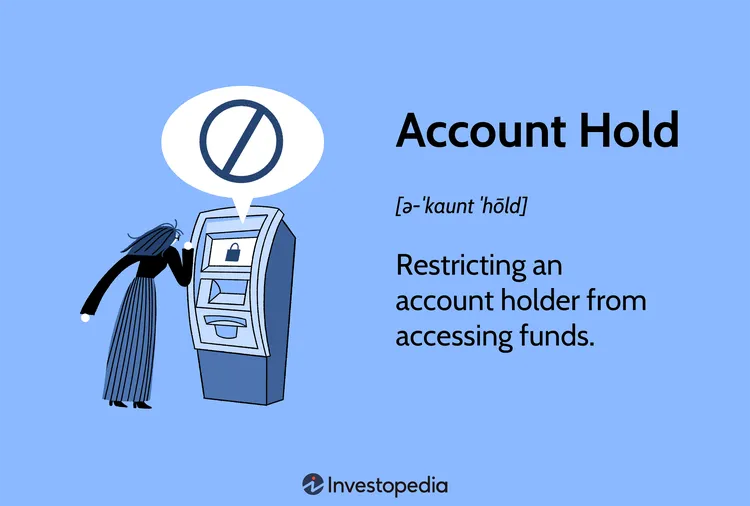
An account hold temporarily limits access to funds in a bank account, often to verify transactions or ensure compliance with banking regulations.
Key Takeaways
- An account hold restricts access to funds to protect both the account holder and the financial institution from potential losses.
- Holds are common with large, out-of-state, or foreign check deposits and when suspicious activity is detected.
- Account holds are temporary and may last a few days, depending on the type of check or the reason for the hold.
- The Expedited Funds Availability Act mandates that banks disclose their hold policies to customers.
- A hold differs from an account freeze, which more strictly prevents transactions, often due to security concerns.
What Is an Account Hold?
An account hold restricts your access to funds, typically imposed by a financial institution to safeguard both you and the bank from potential losses.
Whether due to large or unfamiliar check deposits, collateral pledges, or investigations into suspicious activities, a hold ensures careful fund management until resolutions are reached.
Common Triggers for an Account Hold
- Depositing a large, out-of-state, or foreign check can lead to a hold on your account.
- New accounts are typically subject to holds on initial deposits.
- Funds pledged as collateral for a loan may be temporarily placed on hold
- A bank may temporarily block the use of funds to investigate suspicious activity or identity theft.
Comparing Account Holds and Freezes: What You Need to Know
An account hold is like an account freeze, blocking certain activities. Holds usually delay fund availability, such as after depositing a check. The funds appear in the account but aren’t accessible immediately.
Account freezes stop transactions. They can be set by account holders if a debit card is lost or stolen, or by banks and regulators if they detect suspicious activity.
What Determines the Length of the Account Hold?
The length of the hold depends on the reason. In the case of an unfamiliar source check, the hold can be one or several days. A check drawn from the U.S. Treasury would clear the next day, but a check from a bank outside the country may require several days to clear.
Are Account Holds Regulated?
The Expedited Funds Availability Act (EFAA) of the Federal Reserve Board’s Regulation CC addresses the issue of delayed availability of funds by banks. All banks must disclose their funds-availability policies to their customers.1
Are Holds Placed on Accounts for Criminal Activity?
A government or regulatory authority can prevent access to funds because of suspicious activity, suspected criminal activity, civil actions, or liens filed against the account.2
Final Thoughts on Managing Account Holds
Account holds are temporary restrictions that limit access to funds or halt certain transactions to protect both account holders and financial institutions. Common triggers for a hold include the deposit of large or non-local checks, newly opened accounts, or suspicious account activity.
While holds typically last a few days, their duration can vary based on the hold’s purpose. Under the Expedited Funds Availability Act, banks must clearly disclose their policies to customers, ensuring transparency in fund accessibility.
Compete Risk Free with $100,000 in Virtual Cash
Put your trading skills to the test with our FREE Stock Simulator. Compete with thousands of Investopedia traders and trade your way to the top! Submit trades in a virtual environment before you start risking your own money. Practice trading strategies so that when you’re ready to enter the real market, you’ve had the practice you need. Try our Stock Simulator today >>
Read more
Partner Links